


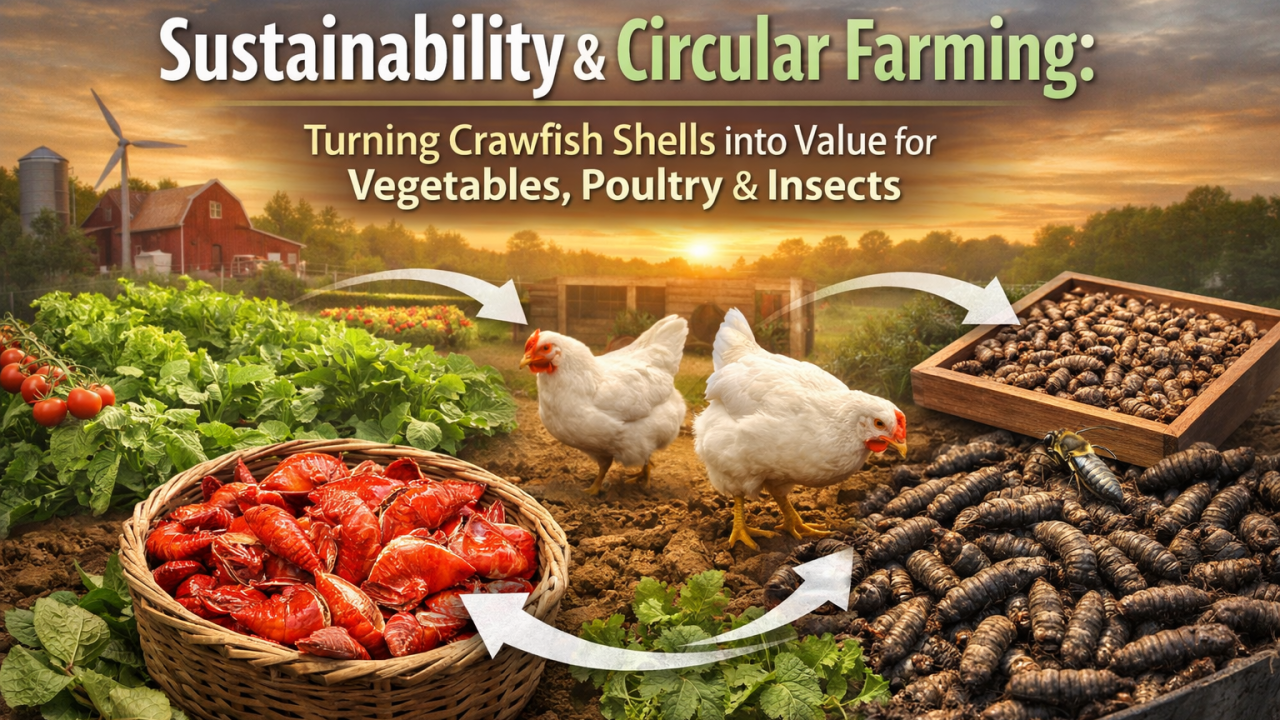
Sustainability is becoming one of the most important priorities in modern agriculture. As farms face rising input costs, growing environmental concerns, and increasing pressure to produce food more responsibly, circular farming is gaining attention as a practical and profitable solution. Also known as circular economy farming, this approach focuses on reducing waste, reusing resources, and creating connected systems where one process supports another.
Instead of following the traditional model of produce, use, and discard, circular farming aims to keep materials in use for as long as possible. Organic waste is no longer seen as something to throw away. It becomes a resource that can be transformed into new value. In agriculture and aquaculture, this opens the door to smarter production systems that are both environmentally friendly and economically efficient.
One of the most promising examples of this concept is the use of crawfish shells in an integrated farming model involving vegetables, poultry, and insect farming. What is often treated as waste can become a valuable input in a sustainable agricultural cycle.
What Is Circular Economy Farming?
Circular economy farming is a farming system built around resource efficiency, waste reduction, and biological recycling. It is inspired by nature, where nothing is wasted and nutrients move continuously through the ecosystem. In a circular farm, outputs from one area are reused as inputs for another, creating a closed-loop or semi-closed-loop production model.
For example, crop residues can be composted and returned to the soil. Poultry manure can be processed into fertilizer. Organic waste can be fed to insect larvae, which in turn can be used as protein for livestock or aquaculture feed. Water, nutrients, and by-products are managed carefully so that less is lost and more is reused.
This is what makes circular farming such a strong pillar of sustainable agriculture. It reduces dependency on outside inputs, lowers waste disposal issues, and supports a more resilient food production system.
Why Sustainability Matters in Farming
Conventional farming often relies heavily on synthetic fertilizers, commercial feeds, and intensive resource use. While these methods can increase production, they may also lead to soil degradation, higher emissions, pollution, and greater vulnerability to price fluctuations.
Sustainable farming aims to balance productivity with long-term environmental responsibility. This means maintaining healthy soil, conserving water, minimizing waste, and making better use of available resources. Circular economy farming strengthens this goal by turning by-products into productive assets instead of environmental burdens.
For farms working in aquaculture, poultry, crop production, or insect farming, the circular model offers a way to connect these sectors into one integrated system.
The Role of Crawfish Shells in Circular Farming
Crawfish shells are rich in organic matter and valuable minerals, particularly calcium. They also contain chitin, a natural biopolymer found in crustacean shells, which has growing value in agriculture and soil health applications. Rather than sending these shells to waste, circular farming systems can incorporate them into a broader nutrient recovery strategy.
When properly processed, crawfish shells can be repurposed in several useful ways. They can be composted with other organic materials, crushed and blended into soil amendments, or used as part of a nutrient input system supporting vegetables, insects, and even poultry-related farm cycles.
This transforms crawfish production from a single-output activity into part of a broader sustainability model. It reduces waste, creates secondary value, and supports other parts of the farm ecosystem.
Crawfish Shells for Vegetable Farming
Vegetable farming depends heavily on healthy soil and balanced nutrition. One of the ways crawfish shells can contribute to sustainable vegetable production is through composting or conversion into organic soil amendments. When combined with plant waste, manure, and other organic materials, crawfish shells can help enrich compost with minerals and organic content.
Their calcium content can be particularly useful in soil-building programs, especially where calcium levels are limited or where growers want to improve soil structure as part of a long-term sustainability strategy. Chitin from shells may also support beneficial soil microbial activity when properly incorporated into composted organic matter.
In a circular farming system, vegetable trimmings and crop waste can later return to the compost stream, creating a nutrient loop. This means crawfish shell waste helps support vegetable growth, while vegetable residues continue feeding the cycle.
The result is a more regenerative farming model where waste is minimized and soil fertility is built over time rather than depleted.
Crawfish Shells, Poultry Farming, and Nutrient Cycling
Poultry farming is another important part of circular economy agriculture because it produces both food and valuable manure. In an integrated system, poultry manure can be composted together with plant residues and crawfish shell waste to produce organic fertilizer for crops. This creates a strong nutrient recycling pathway between aquaculture by-products, poultry operations, and vegetable production.
Crawfish shells can also be part of the wider farm resource stream by contributing minerals and structural material to compost blends. Instead of viewing each farm activity separately, circular farming links them together. Crawfish production supports composting. Poultry manure enhances nutrient richness. Vegetables absorb the nutrients. Crop residues then return to compost or insect bioconversion units.
This integrated approach reduces waste handling problems and helps farms lower their reliance on external fertilizers. It also improves operational efficiency by turning multiple waste streams into productive outputs.
Insect Farming as a Key Link in the Circular Economy
Insect farming is becoming one of the most exciting areas of sustainable agriculture. Species such as black soldier fly larvae are especially valuable because they can convert organic waste into high-protein biomass and nutrient-rich frass. In a circular farming model, insect farming acts as a bridge between waste management and feed production.
Vegetable scraps, poultry-associated organic residues, and other farm by-products can be directed into insect production, depending on local regulations and appropriate processing methods. The insects can then be used as a protein source for poultry, fish, or other livestock, while the frass can be applied as fertilizer for crops.
Crawfish shells can also play a role in this system when incorporated into the broader organic waste processing chain. Rather than isolating aquaculture waste, the circular model brings it into a network where it supports composting, nutrient recovery, and overall farm efficiency.
This creates a highly sustainable cycle. Aquaculture generates shells. Shells help enrich compost or organic amendments. Vegetables grow using recycled nutrients. Vegetable residues and other organic matter feed insects. Insects become a feed ingredient for poultry or aquaculture. Poultry manure and plant waste return to the soil. Every part of the system contributes to another.
Benefits of Circular Farming for Modern Agriculture
The benefits of circular economy farming go far beyond waste reduction. First, it helps farms improve resource efficiency by extracting more value from the same materials. Second, it supports environmental sustainability by reducing disposal pressure, lowering dependence on synthetic inputs, and improving soil health.
Third, it can strengthen farm economics. By converting waste into fertilizer, feed inputs, or secondary products, farms can reduce operating costs and create new value streams. Fourth, circular farming improves resilience. Farms that recycle nutrients and diversify production systems are often better prepared for supply chain disruptions and input price increases.
For businesses involved in aquaculture, poultry, vegetable production, or agritech innovation, circular farming also creates a strong sustainability story for customers, investors, and partners. It reflects responsible resource management and supports the growing demand for environmentally conscious food production.
Building a More Sustainable Future Through Circular Farming
The future of agriculture will depend on systems that are productive, efficient, and regenerative. Sustainability and circular farming are no longer optional ideas. They are becoming essential strategies for farms that want long-term success.
Using crawfish shells in a circular economy farming model is a strong example of how agriculture can move beyond waste and toward value creation. By linking crawfish production with vegetables, poultry, and insect farming, producers can create a smarter and more sustainable system where nutrients are reused, waste is minimized, and every output has a purpose.
This is the power of circular farming. It is not just about reducing waste. It is about redesigning farming so that sustainability becomes part of daily operations, long-term profitability, and food system resilience.
In a world where efficiency, environmental responsibility, and innovation matter more than ever, circular economy farming offers a practical path forward.