


Overview
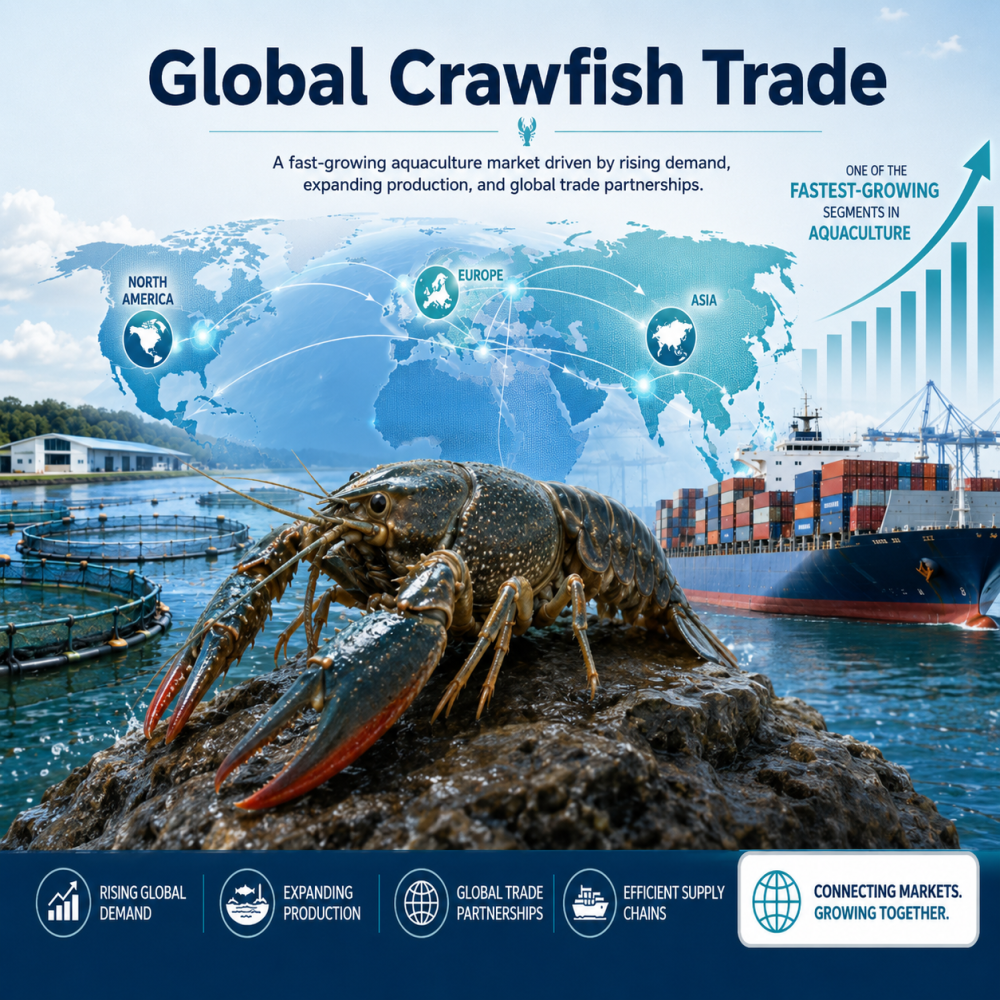
The international crawfish trade represents one of the fastest-growing segments in aquaculture, with demand surging across Asia, Europe, and North America. Crawfish exports have transformed from a niche regional business into a multi-billion-dollar global industry, driven by rising consumer demand, shifting production geographies, and strategic trade partnerships.
📊 Key Insights
1. Market Expansion & Emerging Economies
- China now accounts for ~60% of global crawfish production and 45% of exports by volume
- ASEAN countries (Vietnam, Malaysia, Indonesia) are rapidly scaling production with double-digit annual export growth
- African nations (Kenya, Uganda) are entering the market with cost-competitive production
- Current global export value: ~$2.8 billion USD annually, projected to reach $4.2 billion by 2028
2. Price Volatility & Premium Markets
- Live crawfish export prices fluctuate 30-50% seasonally, driven by supply and Western holiday demand
- European markets pay 15-25% premiums for certified organic and sustainably-farmed crawfish
- USA remains the largest single-country market, consuming 60% of global exports
- Premium grades (Giant/Super Giant sizes) command 2-3x pricing of standard commercial grades
3. Regulatory & Certification Demands
- Import restrictions are tightening: EU now requires disease-free certifications and residue testing
- Organic certification in export markets adds 10-15% production costs but unlocks 30-40% price premiums
- Aquaculture Stewardship Council (ASC) certification increasingly required by major retailers
- Seafood traceability blockchain adoption is rising (15% of major exporters now use it)
4. Logistics & Cold Chain as Competitive Edge
- Air freight (live crawfish) costs $6-12/kg, requiring careful export timing for profitability
- Frozen crawfish export has grown 40% in the past 3 years, reducing logistics bottlenecks
- Temperature-controlled shipping reduces mortality from 15-20% to <3%, improving margins
- Direct-to-consumer export channels are emerging, bypassing traditional middlemen
🔧 Practical Application: Starting Crawfish Exports
Step 1: Regulatory Compliance
- Apply for export licensing with your national fisheries authority
- Obtain necessary certifications (ASC, organic if targeting premium markets)
- Register facilities for inspection and compliance audits
Step 2: Market Selection
- Research tariffs and import quotas for target countries (varies by origin)
- Partner with certified importers/distributors familiar with local regulations
- Consider starting with Asia-Pacific markets (lower barriers) before EU/US
Step 3: Quality & Logistics
- Invest in proper holding tanks with temperature/oxygen monitoring
- Establish partnerships with certified cold-chain providers (airlines, shipping lines)
- Plan shipments around demand peaks: US holidays (Thanksgiving, Christmas), Chinese New Year
Step 4: Pricing Strategy
- Monitor commodity prices daily (export markets are transparent and competitive)
- Build 20-25% buffer into pricing for potential mortality/spoilage during transit
- Offer volume discounts for repeat importers to secure stable contract
📈 Current Market & Industry Context
Recent Shifts (2026):
- China-ASEAN trade boom: Cross-border crawfish trade between Yunnan, Vietnam, and Laos hit record volumes, undercutting traditional U.S. suppliers
- Premium segment growth: Organic and wild-caught crawfish exports are growing 18% annually vs. 6% for standard commercial
- AI-driven traceability: Major exporters now use blockchain and IoT sensors to track temperature/location, reducing disputes