


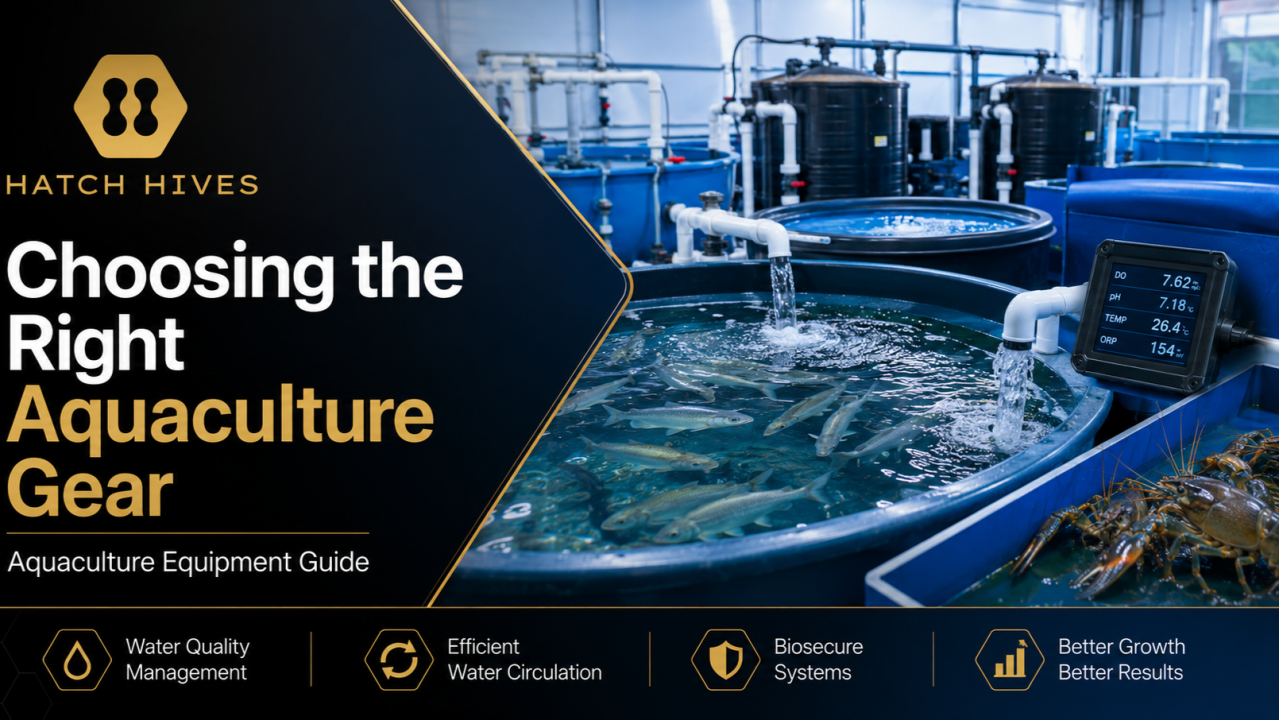
Choosing the right aquaculture gear is one of the most important decisions for any fish farm, hatchery, crawfish farm, or recirculating aquaculture system. The right equipment helps improve survival rates, maintain water quality, reduce labour, and create a more stable production environment.
At Hatch Hives, we believe aquaculture success starts with good system design, reliable equipment, and practical farm knowledge. Whether you are setting up a small hatchery, expanding a crawfish breeding system, or planning a commercial RAS facility, the right aquaculture equipment can make the difference between inconsistent results and scalable production.
Why Aquaculture Gear Matters
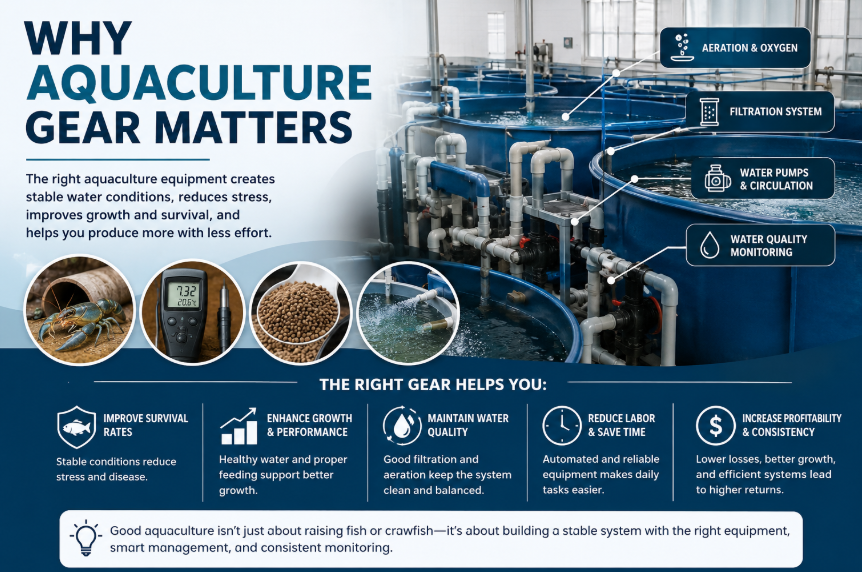
Aquaculture is not only about tanks and animals. It is about creating a controlled environment where aquatic species can grow, breed, and survive with minimal stress.
Poor equipment selection can lead to:
Unstable oxygen levels, poor water circulation, ammonia build-up, inconsistent temperature, high mortality, disease outbreaks, and unnecessary manpower costs.
Good aquaculture gear helps farmers maintain stable water conditions, automate daily operations, improve feeding efficiency, protect livestock, and collect better production data.
For hatcheries and crawfish systems, this is especially important because juveniles, fry, and berried females are highly sensitive to poor water quality and stress.
1. Tank Systems: The Foundation of Aquaculture
The first major decision is choosing the right tank or pond system. Different species and production stages require different setups.
For hatcheries, nursery systems, and crawfish breeding, common options include:
Fiberglass tanks, HDPE tanks, plastic trays, cement ponds, raceways, aquarium display tanks, and modular RAS tanks.
For Cherax quadricarinatus, also known as redclaw crawfish, tank design must consider hiding spaces, stocking density, water exchange, shelter placement, and easy access for inspection. Crawfish are territorial and cannibalism can become a major issue if the system is not designed properly.
Hatch Hives provides practical aquaculture system planning for different production scales, from small learning systems to larger commercial hatchery layouts.
2. Filtration Equipment: Keeping Water Clean and Stable
Filtration is one of the most important parts of any aquaculture system. In a recirculating aquaculture system, filtration allows water to be reused while removing waste and maintaining healthy water conditions.
A strong filtration setup usually includes:
Mechanical filtration to remove solids, biological filtration to convert ammonia and nitrite, and optional chemical or polishing filtration to improve water clarity.
For modern aquaculture, the most important filtration components include drum filters, sponge filters, filter mats, bio-media chambers, moving bed biofilters, settlement tanks, and protein skimmers for certain systems.
A good filter system should match the stocking density and feed input. Under-sized filtration is one of the most common reasons aquaculture farms face water quality problems.
At Hatch Hives, we focus on equipment planning that matches the real production load, not just the tank size.
3. Aeration and Oxygen Systems
Dissolved oxygen is critical in aquaculture. Fish, crawfish, beneficial bacteria, and overall system health all depend on proper oxygen levels.
Important oxygen and aeration equipment includes:
Air blowers, air pumps, air stones, diffuser discs, oxygen cones, venturi injectors, backup oxygen cylinders, and dissolved oxygen meters.
In high-density systems, oxygen demand can rise quickly, especially during feeding, high temperature, or system stress. For crawfish farms and hatcheries, poor oxygen levels can cause animals to become weak, overturn, stop feeding, or die.
A well-designed aquaculture system should include both daily aeration and emergency oxygen backup.
Hatch Hives helps farmers design oxygen systems that support stable production and emergency resilience.
4. Water Pumps and Circulation
Water movement affects oxygen distribution, waste removal, filtration efficiency, and overall animal health.
The key equipment includes:
Submersible pumps, external pumps, circulation pumps, pipework, valves, flow meters, drain systems, and backup pumps.
For RAS systems, pump selection should consider flow rate, head pressure, power consumption, pipe size, and maintenance access. A pump that is too weak will reduce filtration performance. A pump that is too strong may create unnecessary stress or energy cost.
For crawfish systems, water flow should be stable but not too aggressive. Crawfish need oxygenated water, but they also require calm areas and shelters to reduce stress.
5. Water Quality Testing Equipment
You cannot manage what you do not measure. Water quality testing equipment is essential for every aquaculture farm.
Basic water quality tools should include:
pH meter, dissolved oxygen meter, temperature meter, ammonia test kit, nitrite test kit, nitrate test kit, TDS meter, salinity meter, alkalinity test kit, hardness test kit, and ORP meter.
For commercial farms, water quality should be recorded daily. Over time, these records help identify trends before they become serious problems.
Important parameters to monitor include:
pH, temperature, dissolved oxygen, ammonia, nitrite, nitrate, salinity, alkalinity, hardness, calcium, magnesium, and total dissolved solids.
Hatch Hives encourages farmers to combine equipment with proper record-keeping and standard operating procedures. Good equipment only works well when it is used consistently.
6. Feeding Equipment
Feeding is one of the biggest operating costs in aquaculture. Proper feeding equipment helps reduce waste, improve growth, and protect water quality.
Depending on the scale, farms may use:
Manual feeding trays, automatic feeders, belt feeders, feed storage containers, weighing scales, feed scoops, and feeding record sheets.
For crawfish, feeding must be managed carefully because uneaten feed can quickly pollute the water. Feed should be adjusted based on animal size, stocking density, temperature, moulting activity, and mortality trends.
Hatchery and nursery systems should use simple feeding records so staff can track feed input, growth, and survival.
7. Shelter, Grading, and Handling Gear
For crawfish farming, shelter is not optional. It is a core part of production design.
Important crawfish gear includes:
PVC shelters, netting, mesh hides, grading trays, sorting baskets, hand nets, holding boxes, transport containers, and nursery trays.
Shelter helps reduce fighting and cannibalism, especially during moulting. Grading equipment is also important because size differences can increase predation and stress.
For hatcheries, gentle handling is important. Poor handling can damage juveniles, berried females, or soft-shell animals.
Hatch Hives designs aquaculture gear recommendations based on the species, life stage, and farm workflow.
8. Heating and Temperature Control
Temperature affects metabolism, feeding, growth, breeding, and disease risk.
Common temperature control equipment includes:
Aquarium heaters, titanium heaters, heat pumps, chillers, thermostats, temperature sensors, insulation materials, and backup temperature alarms.
For crawfish and many tropical aquaculture species, stable temperature is more important than chasing extreme growth. Sudden temperature swings can create stress and affect breeding performance.
Temperature control should be designed together with water volume, room insulation, weather patterns, and power backup.
9. Backup Power and Emergency Equipment
Every aquaculture farm needs an emergency plan. Power failure can cause oxygen crashes, pump failure, filtration collapse, and mass mortality.
Essential emergency gear includes:
Generator, battery backup, oxygen cylinders, backup air pumps, spare water pumps, extension cables, fuel storage, emergency lighting, and alarm systems.
For RAS and hatchery operations, backup planning is not a luxury. It is a basic requirement.
At Hatch Hives, we strongly recommend building emergency systems into the farm design from day one.
10. Automation and Monitoring Systems
Modern aquaculture is moving toward smarter, more automated systems. Automation helps reduce human error, improve response time, and simplify reporting.
Useful automation tools include:
Water quality sensors, digital dashboards, automatic feeders, alarm systems, camera monitoring, Google Sheets reporting, farm management software, QR-based logging, and automated daily reports.
For farms with multiple sites or large teams, automation can reduce workload and improve accountability.
Hatch Hives supports aquaculture businesses by combining farm equipment planning with backend automation, reporting systems, SOPs, and operational dashboards.
How to Choose the Right Aquaculture Equipment
Before buying aquaculture gear, ask these questions:
What species are you farming? What life stage are you managing? What is your stocking density? What is your target production volume? How much labour is available? Is the system indoor or outdoor? Do you need RAS, flow-through, or pond-based design? What is your backup plan during power failure? How easy is the equipment to clean and maintain?
The best equipment is not always the most expensive. The best equipment is the one that fits your farm design, production goals, staff capability, and water quality requirements.
Why Choose Hatch Hives?
Hatch Hives is built for practical aquaculture development. We focus on systems that are realistic, scalable, and suitable for daily farm operations.
Our aquaculture support includes:
Aquaculture equipment planning, RAS system design, crawfish hatchery setup, water quality management, farm workflow design, nursery system planning, SOP development, automation dashboards, and production reporting.
We understand that successful aquaculture is not only about buying equipment. It is about building a complete system where water, livestock, staff, equipment, and data work together.
Whether you are starting a small aquaculture project or expanding into commercial production, Hatch Hives can help you choose the right aquaculture gear and build a system that supports long-term success.
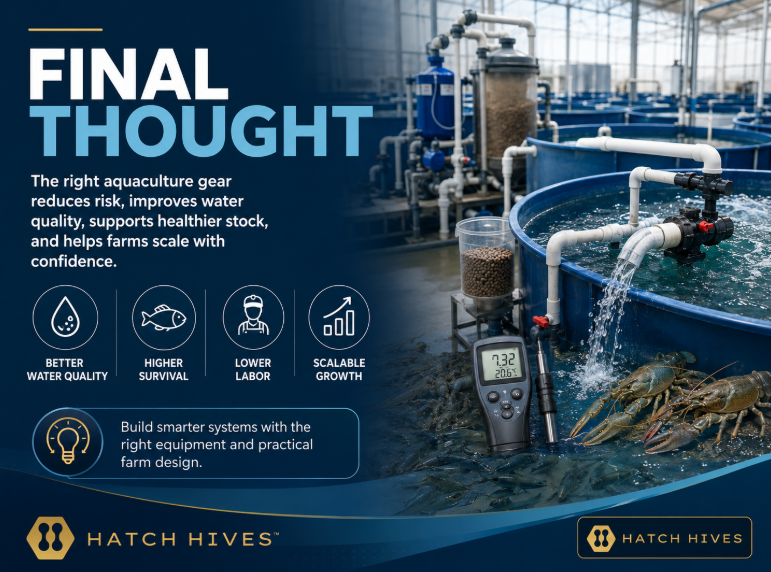
Choosing the right aquaculture equipment is one of the most important steps in building a productive and reliable farm. Tanks, filters, pumps, aeration, testing tools, feeding systems, shelters, backup power, and automation all play a role in farm performance.
For fish farmers, crawfish farmers, hatchery operators, and RAS developers, proper equipment selection reduces risk and improves production stability.
With the right planning and support from Hatch Hives, aquaculture can become more efficient, more measurable, and more scalable.
Looking to build or improve your aquaculture system? Hatch Hives provides practical aquaculture equipment guidance, RAS planning, and crawfish hatchery solutions designed for real farm operations. For more information, contact www.hatchhives.com