


.jpeg)
Artificial Intelligence (AI) and smart monitoring technologies are transforming aquaculture into a precision, data-driven industry. As seafood demand rises and environmental pressures increase, farms are adopting real-time monitoring systems to improve productivity, sustainability, and risk management.
Modern smart aquaculture combines sensors, connectivity, analytics, and automation to maintain optimal water conditions and animal health — often with minimal manual intervention.
Key Parameters Monitored x Water Quality Core Metrics
- Dissolved Oxygen (DO) = Survival and Growth
- Temperature = Metabolism Control
- pH = Stress and Toxicity risk
- Ammonia/Nitrite = Waste Toxicity
- Salinity & TDS = Osmoregulation
- ORP = Cleanliness
- Turbidity = Suspended Waste
Continuous monitoring allows farmers to detect dangerous trends before they become catastrophic.
🤖 AI-Driven Feeding Optimization
Feed is typically the largest operational cost in aquaculture. AI systems analyze animal behaviour, appetite, and environmental conditions to deliver precise feeding.
Benefits:
- Reduced feed waste
- Faster growth rates
- Lower water pollution
- Improved profitability
Computer vision cameras can even detect uneaten feed and automatically adjust rations.
🎥 Computer Vision Applications x Underwater AI Cameras
- Estimate stock density
- Measure size distribution
- Detect abnormal behaviour
- Identify stress indicators
- Monitor molting cycles (crustaceans)
This reduces handling stress while providing continuous biomass insights.
🚨 Predictive Disease & Risk Management
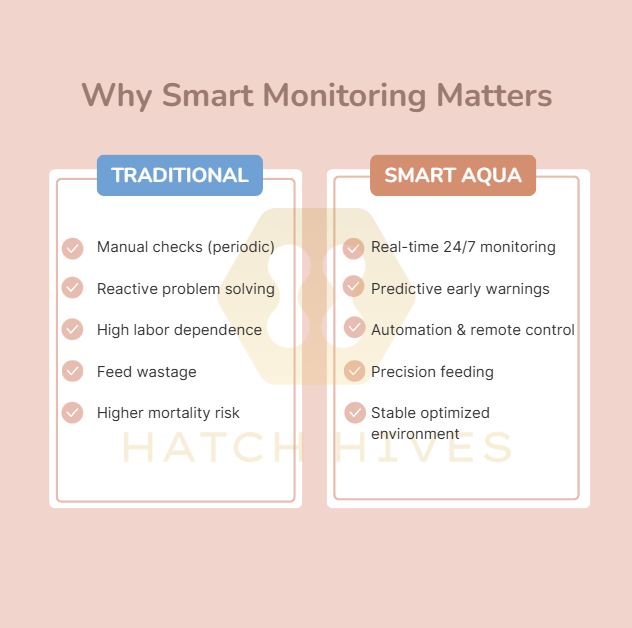
AI models analyse water trends, behaviour patterns, and historical data to detect early warning signs of disease outbreaks. Early intervention can reduce mortality, lower chemical usage, improved biosecurity and stable production cycles.
⚙️ Automation & Remote Farm Control
Smart monitoring systems can directly control equipment to maintain ideal conditions. Automated responses include: Activating aerators when oxygen drops, adjusting filtration and water exchange, regulating temperature in indoor systems and sending real-time alerts to operators. Many farms can now be monitored and managed remotely via mobile devices.
🔮 The Future of AI in Aquaculture
Emerging innovations include Autonomous farming systems, Digital twin simulations, Robotics for inspection and cleaning, AI-optimized breeding programs and Integration with climate and satellite data.
Conclusion
AI-powered monitoring is transforming aquaculture from a reactive practice into a predictive, precision industry. By combining real-time sensing, machine learning, and automation, smart farms can maximize yields, reduce risks, and operate sustainably.
The future of aquaculture is not just about producing more seafood — it is about producing it smarter, safer, and more responsibly.