


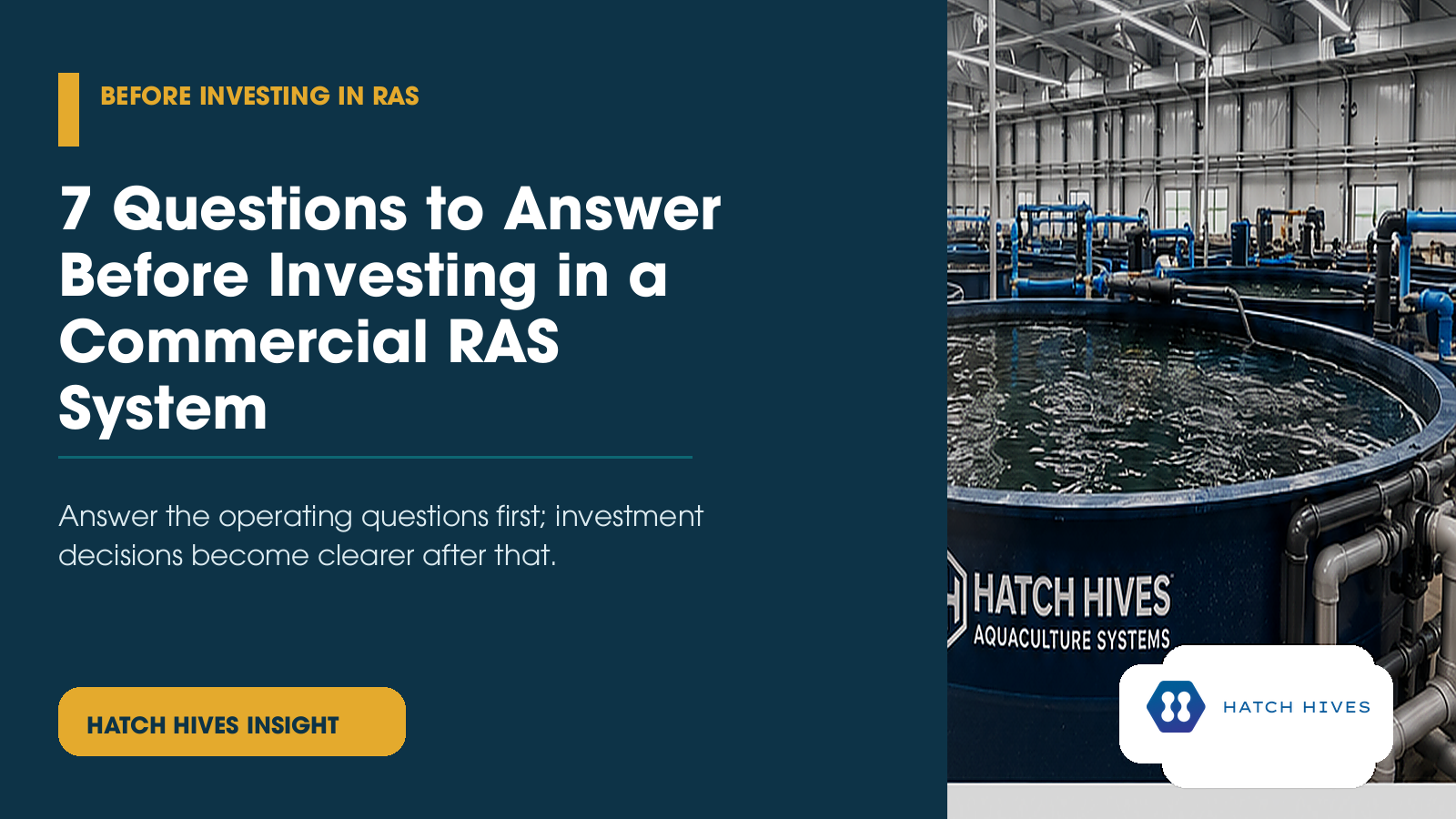
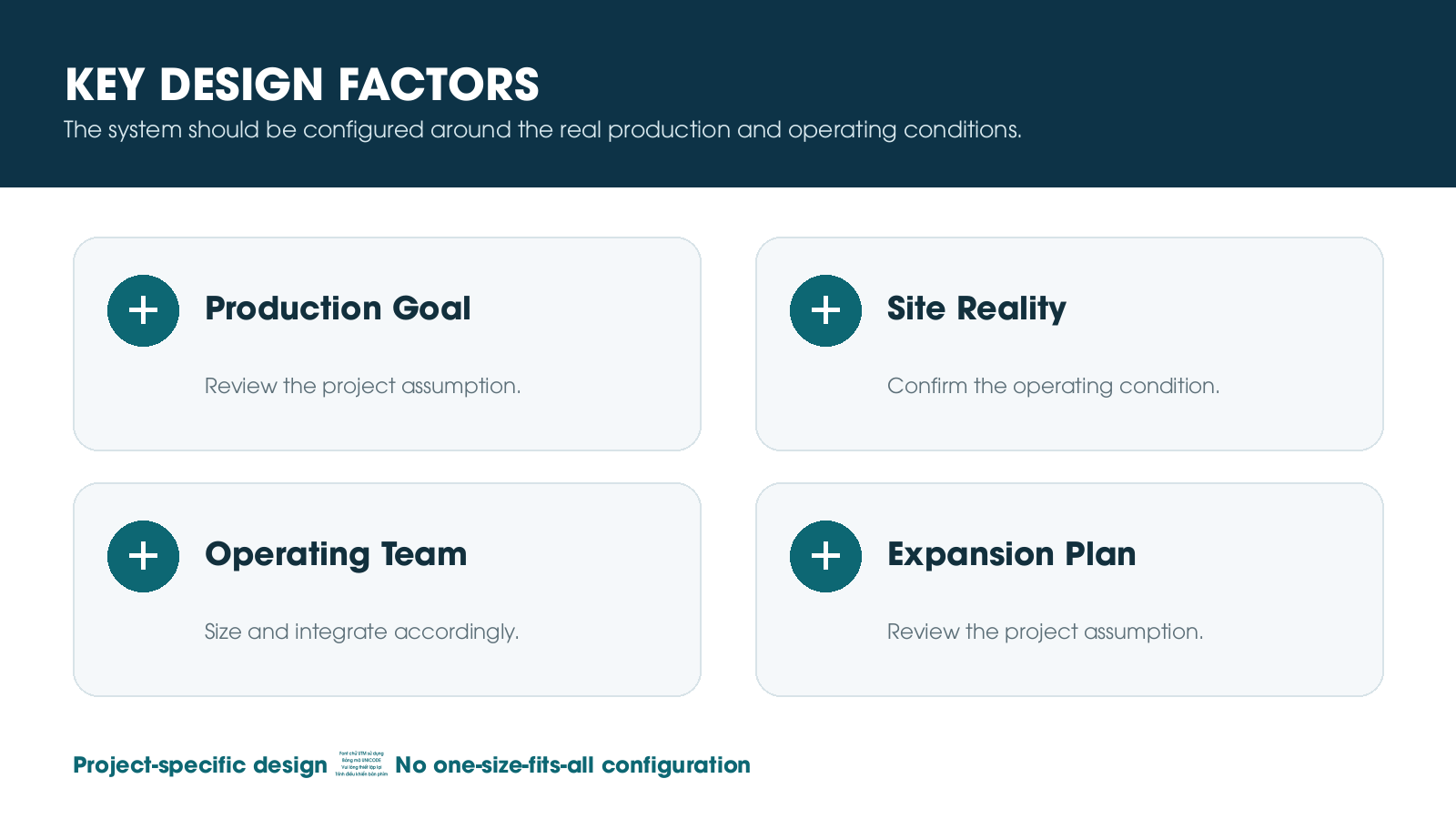
Commercial RAS can provide a high level of control over the production environment, but the technology still needs to match the biology, site and operating capability of the farm. Before discussing equipment prices or return on investment, answer the questions that determine what system you actually need. Hatch Hives' FAQ reinforces this approach by stating that there is no one-size-fits-all RAS or CRAS solution.
1. What species and life stage are you farming?
Species affects temperature, salinity, oxygen, water chemistry, behaviour and husbandry. A hatchery or nursery may also have different priorities from grow-out. The system should be designed around the production biology rather than adapted later after equipment has been chosen.
2. What is the target production output?
Define what the farm is expected to produce and in what cycle. That provides the commercial objective. Then translate the objective into standing biomass, stocking plan and feed assumptions that can be used for engineering. If the production plan is still being tested, consider whether a pilot phase is appropriate before scaling.
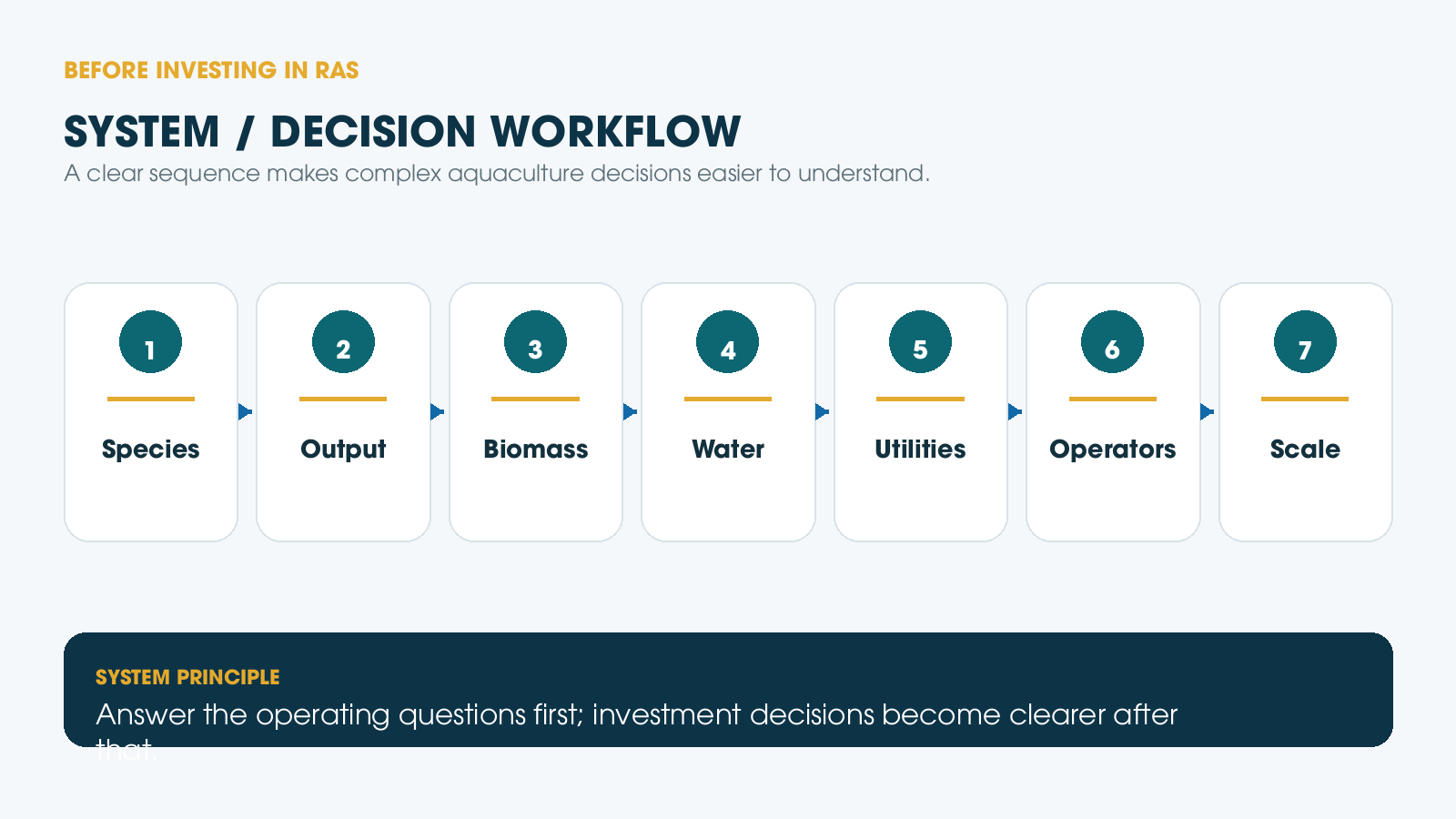
3. What is the maximum biomass and feed load?
Tank volume does not tell you how much load the treatment system must handle. Biomass and feed input influence solids, dissolved waste and oxygen demand. A sizing discussion should therefore include the peak operating condition rather than only the average day.
4. What water source and site conditions are available?
Freshwater or seawater, temperature, source-water quality, floor area, drainage and access all affect system design. The Compact RAS product page, for example, lists separate freshwater and seawater scenarios. The correct configuration still depends on the project around that equipment.
5. What utilities and backup systems are available?
Power, water, air, oxygen, heating or cooling, communications and backup power can become critical parts of the operating plan. A system should not be designed without understanding which utilities are reliable on the site and what contingency planning the farm needs.
6. Who will operate and maintain the system?
RAS requires routine observation, cleaning, monitoring and maintenance. Hatch Hives' consultation scope includes training, troubleshooting and maintenance support, but the farm team still needs a clear daily routine and enough technical understanding to respond to changes.
7. How will the project scale?
A pilot, a compact system, a customised RAS and a containerised CRAS can support different development strategies. Think about future tanks, treatment capacity, utilities and site expansion before locking the first phase. A modular route can be useful, but only if the expansion logic is planned from the beginning.
Investment starts with engineering clarity
Financial evaluation becomes more meaningful once the system scope is based on real production assumptions. Instead of asking for a universal payback period, build the project model around the selected species, expected output, site costs, utilities, labour, maintenance and market assumptions. The engineering assessment provides the technical basis for that financial work.
Practical next step
Once these seven questions have answers, the investment discussion becomes more disciplined. The farm can connect expected production to a defined technical scope, then build a financial model around real site costs, equipment, utilities, labour and market assumptions. If critical inputs are still unknown, the correct next step may be more feasibility work or a pilot rather than a larger equipment purchase. In that sense, good RAS planning reduces uncertainty before capital is committed, even when it cannot eliminate every commercial risk.
Project-specific note
This approach also makes later supplier comparison easier because competing proposals can be checked against the same production brief instead of being judged only by headline equipment prices.
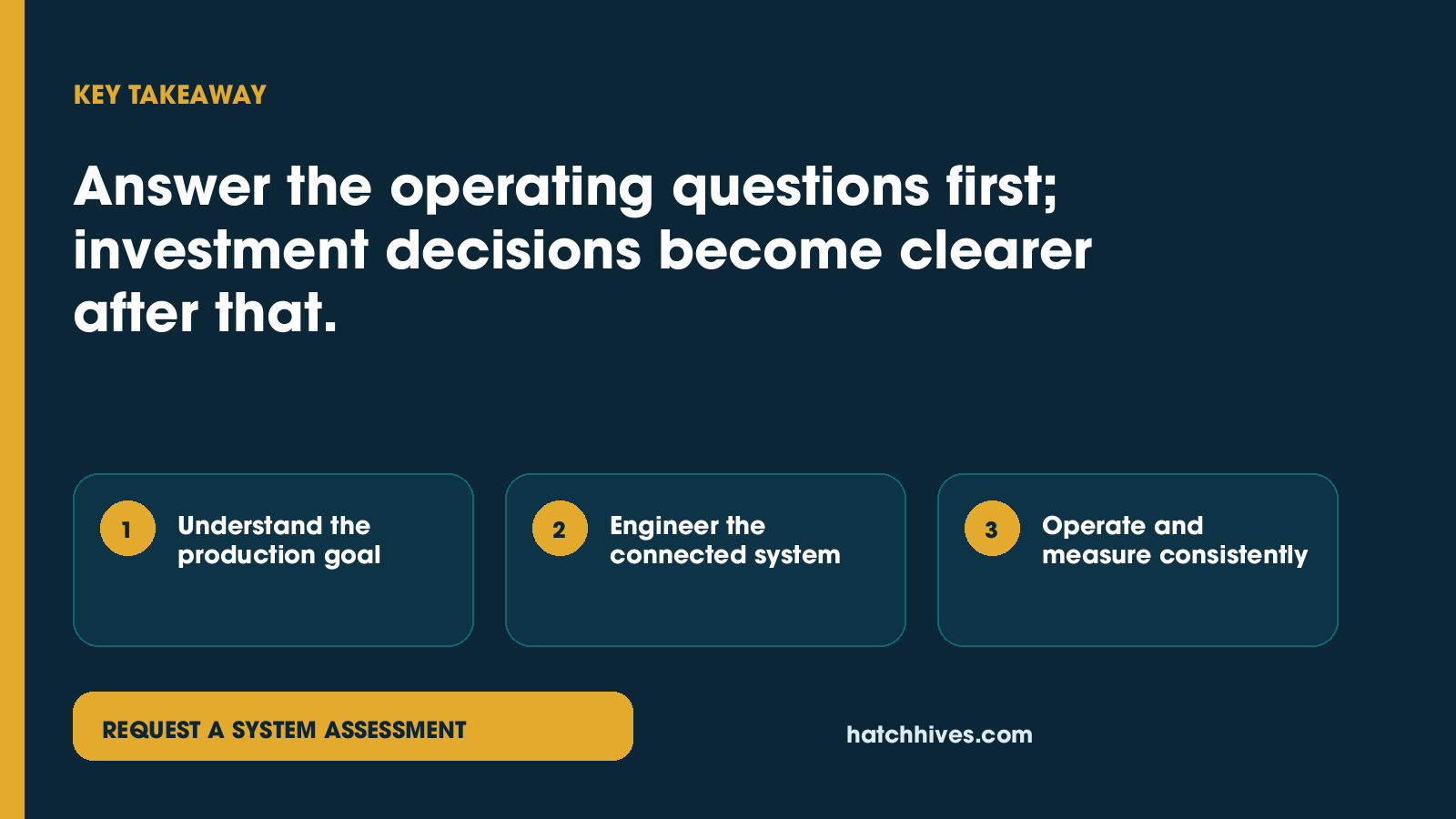
Next step: Request a preliminary RAS investment and system-scope discussion.
Seven practical questions to answer before investing in a commercial RAS system, covering species, output, biomass, site, utilities, operators and scale.